
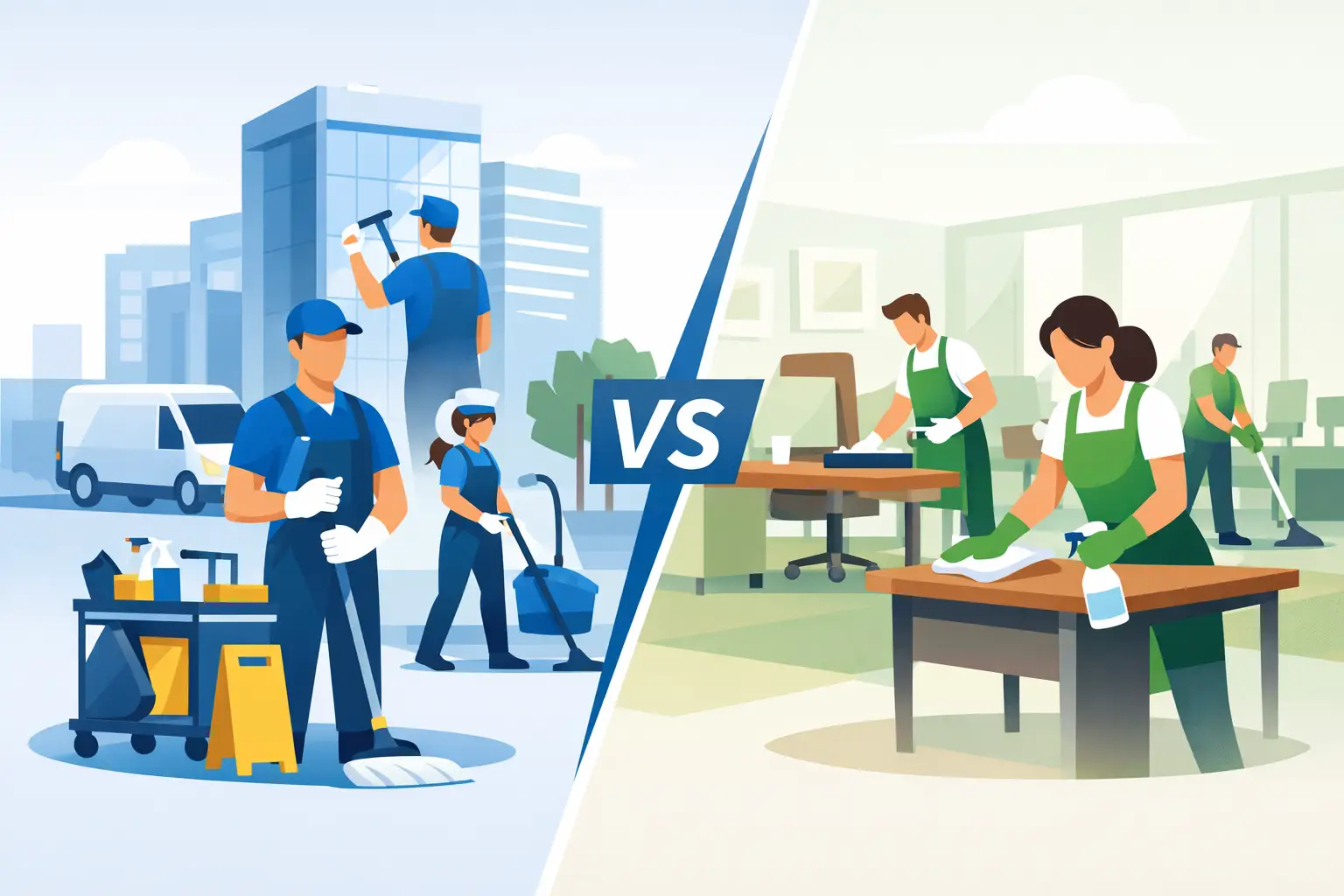
A spotless lobby at 8:00 a.m. means very little if the restrooms run out of supplies by noon, fingerprints build up in meeting rooms by three, and no one notices the scuffing on your stone floors until the damage is already done. That is where the real question behind commercial cleaning vs in house begins. It is not simply about who empties bins or vacuums carpets. It is about who protects the standard of your workplace, who notices wear before it becomes costly, and who can deliver consistency without demanding constant supervision.
For office managers, property managers, and business owners, the choice is rarely as simple as cost on paper. The right answer depends on your building, your risk tolerance, your internal capacity, and the level of finish your space is meant to reflect. A polished environment shapes staff morale, visitor perception, tenant satisfaction, and asset longevity. Cleaning is operational, but it is also reputational.
Commercial cleaning vs in house: what is the real difference?
An in-house cleaning model means the people responsible for cleaning are your employees. You recruit them, train them, schedule them, supply them, and manage performance internally. That can offer a strong sense of control, especially for businesses with large facilities or unusual operational hours.
Commercial cleaning, by contrast, means hiring a professional service provider to deliver cleaning under an agreed scope. The provider manages staffing, training, equipment, chemicals, compliance, and quality control. In a premium model, that can also include tailored routines, specialist surface care, and proactive reporting when a facility needs more than routine upkeep.
On the surface, one model looks internal and the other outsourced. In practice, the difference is who carries the burden of execution. That burden includes far more than the visible act of cleaning.
Cost is rarely as straightforward as it looks
Many businesses assume in-house cleaning is cheaper because the hourly wage may appear lower than a contractor invoice. That can be true in some settings, particularly if you have scale, an experienced facilities team, and stable staffing. But wage cost is only one layer.
With in-house staff, you also absorb recruitment time, payroll administration, leave coverage, workers’ compensation, onboarding, training, supervision, consumables, equipment purchase, repairs, storage, and replacement when staff leave. There is also the hidden cost of inconsistency. If standards slip, the financial impact may show up as damaged finishes, avoidable complaints, or management time spent troubleshooting routine issues.
Commercial cleaning tends to look more expensive at first because the quote bundles those responsibilities into one line item. Yet that bundled price often buys predictability. You are paying for systems, not just labor. If one cleaner is sick, the service provider is expected to fill the gap. If a delicate surface needs the wrong chemical avoided, that knowledge should already be part of the method. For many businesses, that transfer of operational strain is worth more than the apparent savings of running cleaning in-house.
Quality depends on standards, not just effort
There is a common belief that in-house teams care more because they are part of the company. Sometimes that is absolutely true. A long-standing internal cleaner can become deeply invested in the rhythm of a workplace and spot issues before anyone else does.
But care without systems can only go so far. Quality in cleaning is not just effort. It is method, product knowledge, sequencing, equipment choice, and attention to surfaces that need protection rather than harsh treatment. High-traffic commercial spaces often include stone, glass, stainless steel, specialty flooring, upholstered seating, and touchpoints that require different handling. A rushed clean can make a space look acceptable for an hour while slowly shortening the life of the materials.
A strong commercial provider brings trained eyes and repeatable standards. That matters most in spaces where presentation carries weight – client-facing offices, boutique retail, medical-adjacent environments, premium residential buildings, and shared facilities where every missed detail becomes visible. When the expectation is not basic tidiness but an elevated, cared-for finish, expertise becomes part of the value.
Oversight: control can be a comfort or a burden
Businesses often choose in-house teams because they want direct oversight. If something needs to change, they can walk downstairs and address it immediately. There is comfort in that closeness.
The trade-off is that someone inside the business must own the cleaning function. Schedules need adjusting. Supplies need ordering. Performance needs monitoring. Training needs refreshing. If standards drift, the issue becomes internal management work, not simply a service conversation.
With commercial cleaning, the ideal arrangement is different. You set expectations, but you do not have to manage every motion. A well-run provider should have supervisors, checklists, accountability processes, and a clear escalation path. That structure can feel less personal if you choose a low-cost vendor. It can feel far more professional if you choose a partner that treats your facility as an asset rather than a contract.
This is often where premium providers separate themselves from commodity operators. The difference is not just whether the floor is clean. It is whether the service feels considered, responsive, and precise.
Flexibility matters more than most businesses expect
Your cleaning needs are unlikely to stay static. Headcount changes. Tenants move in or out. Seasonal traffic rises. Renovation dust appears. An executive visit gets added at the last minute. Restrooms need more frequent attention during events. A simple nightly routine can quickly become inadequate.
In-house teams can be flexible when they are fully staffed and well led. But small internal teams are vulnerable to disruption. One absence can affect the entire routine. Specialist tasks may also fall outside their training or equipment range.
Commercial cleaning usually offers broader flexibility. Service scopes can expand or tighten, frequencies can shift, and specialist work can be added without rebuilding your staffing model. That matters for businesses that want routine cleaning, periodic deep cleaning, window care, post-construction support, or presentation resets before inspections and handovers. Flexibility is not just convenience. It is resilience.
Commercial cleaning vs in house for different facility types
A single-site office with predictable hours may function well with an in-house cleaner, especially if leadership wants daily visibility and the standard required is straightforward. Warehouses and industrial settings sometimes lean this way too, particularly when cleaning is closely tied to on-site operations.
Multi-tenant properties, premium offices, medical-adjacent spaces, and facilities with varied surface types often benefit more from commercial cleaning. These environments tend to require stronger reporting, broader skill sets, and more dependable coverage. They also carry more reputational risk when standards slip.
If your building is part of the customer experience, outsourced professional cleaning usually earns its place faster. Visitors may not comment on a well-kept reception area, but they certainly notice when glass is streaked, floors are dull, or restrooms feel neglected.
When in-house makes sense
There are cases where keeping cleaning internal is the better decision. If your operation demands constant daytime cleaning presence, if your facility has unusual security requirements, or if you already have a mature facilities management structure, an in-house team can work beautifully. The key is whether you are willing to invest in proper training, quality control, and equipment.
This approach also suits organizations that want cleaning staff deeply embedded in company culture and can offer enough hours to retain good people. In-house only becomes risky when it is treated as an afterthought. If you want premium standards from an internal team, it still requires premium discipline.
When commercial cleaning is the stronger choice
Commercial cleaning is often the stronger option when consistency matters more than micromanagement. It suits businesses that want reliable execution without carrying recruitment and supervision burdens internally. It is also the better fit when your space includes delicate finishes, varied cleaning needs, or presentation standards that influence client trust.
In markets like Adelaide, where businesses often balance polished presentation with lean operations, this model can give decision-makers breathing room. A provider such as Rosewood & Luster is not merely there to remove dust. The value is in preserving surfaces, supporting a calm and credible environment, and delivering routines tailored to how the property actually functions.
That tailored element matters. Not every commercial site needs the same frequency, same products, or same level of detail. A quality provider will build around your traffic patterns, risk points, and finish expectations rather than forcing your building into a generic checklist.
The better question to ask
Instead of asking which model is cheaper, ask which one gives you the standard you need with the least friction and the lowest long-term risk. A cheaper arrangement that leads to damaged flooring, missed hygiene issues, or ongoing management headaches is not truly economical.
The best cleaning model is the one that protects your environment without making cleanliness another full-time problem for your team. For some businesses, that will be in-house. For many, it will be a commercial partner with the systems, craftsmanship, and consistency to care for the space properly.
A well-kept workplace should feel quiet in the best way – orderly, intentional, and effortlessly maintained. When cleaning is handled well, your people can focus on their work and your space can continue doing its own subtle work of building trust.
Leave a Reply